
Squash Vine Borers

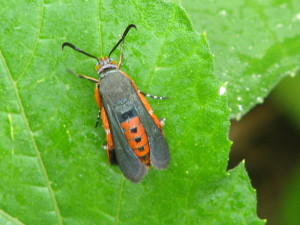
This is the moth phase of the garden pest, Squash Vine Borer.

Have you seen this moth flitting around your squash plants? Look closely. It is has a greenish black top wing and transparent, black-veined bottom wing and is often confused with a wasp. It buzzes when it flies. Unlike most moths, it flies in the daytime.

The Squash Vine Borer, Melitta curcurbitae, is a serious pest of vine crops, commonly attacking summer squash, winter squash, and pumpkins. Cucumbers and melons are less frequently affected.
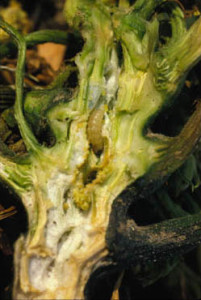
squash vine borer larva
The Squash Vine Borer larvae make a hole near the base of the stem and crawl inside to feed for 4-6 weeks.

Soon after emerging, squash vine borers lay flat, brown eggs singly at the base of susceptible plants. Approximately one week after they are laid, the eggs hatch and the larvae bore into stems to feed. The larvae feed through the center of the stems, blocking the flow of water to the rest of the plant. The larvae feed for four to six weeks, then exit the stems and burrow about one to two inches into the soil to pupate. They remain there until the following summer. There is one generation per year.

The best thing to do is intervene before eggs hatch and larvae bore into the vines. You may find that placing a yellow container of water may attract and trap the adult Squash Vine Borers. If larvae have already taken up residence, some sources recommend slitting the stem of affected plants and killing the larvae. After extracting the larvae, cover the opening with damp soil and keep it watered. Hopefully roots will develop and the plant may survive.

Promptly pull and destroy any plants killed by squash vine borers. You do not want the larvae to enter the soil under your squash plants only to emerge next year as moths.

Similar Posts

  • |

    Lady Bugs

    One of our most beneficial garden bugs are here at the Garden in increasing numbers.  They are being attracted by Aphids and other soft body insects that are on our remaining winter and some early spring plants. I’ve left some Dill plants to seed in a growing bed, which also attracted Aphids, which attracted to…

  • | |

    Crop Rotation

    Rotating your planting scheme is one of the things that hasn’t really gotten a lot of discussion yet, but everyone should give it some serious consideration this year. Different plant families use up different things from the soil, are attractive to different pests, harbor different diseases, etc. Crop rotation helps address these issues and keep…

  • | |

    Harlequin Bugs

    The first week of May, 2014, many gardeners reported seeing this bug on broccoli that had bolted and other plants in the brassica family. This pest is Murgantia histrionica, also known as the Harlequin Bug or Cabbage Bug. Harlequin bugs come because there are plants that are past their prime. They especially like all the brassica…

  • Cucumber Beetles

    This garden pest, the Spotted Cucumber Beetle, has been seen at Westbury Community Garden beginning in May. We also may see the smaller Striped Cucumber Beetle and Green Banded Cucumber Beetle. All three of these have small black heads. They are evasive and hard to catch/kill, as they fly off quickly. Their eggs are yellow, oval and…

  • |

    Ditch the Bug Zappers, Try This Instead

    We gardeners are all plagued to a varying extent by blood sucking, disease-spreading, itchy Mosquitoes in the Houston area. Currently they’re not especially annoying at WCG until dusk. But this will likely change with heavy rains & absent lovely summer breezes. I’ve read that rubbing native American Beautyberry leaves on your skin is a natural…