Harvest Your Winter Crops!

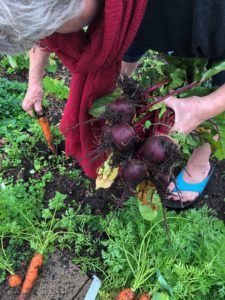
A beautiful January harvest of beets and carrots. Snap and snow peas, kale, spinach and lettuce are also ready.

Some timely advice from our experienced gardeners —

Don’t let your winter crops bolt!

Seriously! Harvest your crops while it’s cool and the plants are in good condition. Vegetables planted in September and October are ready to harvest now. If you neglect to harvest at the peak time, you may notice

  1. Animals start to gnaw on them, especially the shoulders of carrots, turnips and other root crops.
  2. Some root crops may begin to rot.
  3. Lettuces will bolt. This means they will grow a stalk at the center of the head in order to produce flowers and bloom. The plant wants to produce seeds. It usually doesn’t taste as good when it bolts.
  4. Broccoli, which is a flower, will rapidly bloom if it is not picked. The nice thing about broccoli is if you pick it, it will produce more broccoli, though not as big a head as the first one.

Try not to let your produce go to waste! Harvest. Eat as much as you can. Share your bounty with friends.

And more words of wisdom —

Additionally, with the warming, humid weather, the destructive insects are arriving. We see
  • numerous small black beetles which chew small holes in Mizuna, radish & other greens
  • small Army worms which eat lettuces, cabbage, bok choy,  etc.
  • tiny green cutworms which blend in with the greens they feed upon
  • and of course, the year round Doodle Bugs which feed on root vegetables & rotting vegetables.
Did you know, the flowers forming on Cressida, Sylvetta Arugula & other spicy vegetables, are edible and very tasty? Add them to your salads!

Similar Posts

  • | | |

    Support For Plants

    Some plants must be supported to be at maximum production. These plants are tomatoes, peppers, eggplant, cucumbers, long beans, pole beans, bitter melon, Malabar spinach. Tools: The garden’s two handled fence post driver is in the small shed. (See photo.) Trellises are for cucumbers, long beans, pole beans, bitter melon, Malabar spinach. Trellises can be…

  • | |

    Weeding and Disposal

    Weekly weeding of your garden and the surrounding aisles are essential. No weed killers/ herbicides are used in WCG. Learn to know weeds and how they grow which enables you to remove them effectively. Once a weed flowers, it produces seeds which quickly become more weeds.  Therefore, pull out even small weeds. Acquire a good…

  • |

    Tomato Preferences

    Since we have a lot of new gardeners, I thought it would be helpful to recirculate this information I sent last spring to those of you that are having trouble deciding what tomatoes to plant. Heirloom vs. Hybrid There are two types of tomatoes available at nurseries. Most agree that the heirloom varieties taste better…

  • | |

    Black Rot Disease in Brassicas

    What is it? Black rot is a bacterial infection that affects the vascular system of members of the Brassica (broccoli) family. It is caused by the bacterium Xanthomonas campestris pv. campestris. Which plants are affected? All cruciferous crops are susceptible including arugula, bok choy, broccoli, Brussels sprouts, cabbage (including Chinese cabbage), cauliflower, collards, garden cress, kale, kohlrabi, mustard (including mizuna), radish, rutabaga, and turnip. NOT AFFECTED seems to be nasturtium (it must be far enough away on the family tree). Where did it come from? We don’t know the origin of our current outbreak. The bacterium infects all parts of host plants, including seeds, so it could have come in on a seed or on a commercial transplant. There are also some Brassica family weeds that can harbor it in the wild. Why is it such a problem now? We have had the perfect warm, humid weather for it to spread and multiply these past few months – temperature has been between 50-75,  it has been breezy and wet. It wasn’t until Wayne saw the same pattern on several of his plants that he brought it to Ray’s attention. We’ve probably been living with it for months without realizing it, which allowed it to spread widely. How is it spread?…